Search is changing again.
For years, B2B marketers built visibility around traditional search behavior. Buyers searched for a problem, clicked through results, read articles, compared vendors, and eventually landed on a website or campaign page. The strategy was familiar: create useful content, optimize for keywords, improve rankings, and capture demand through forms or calls to action.
That model still matters. Search engines are not disappearing. SEO is still important. Buyers still use websites, blogs, comparison pages, and landing pages to make decisions.
But AI search is changing the way discovery works.
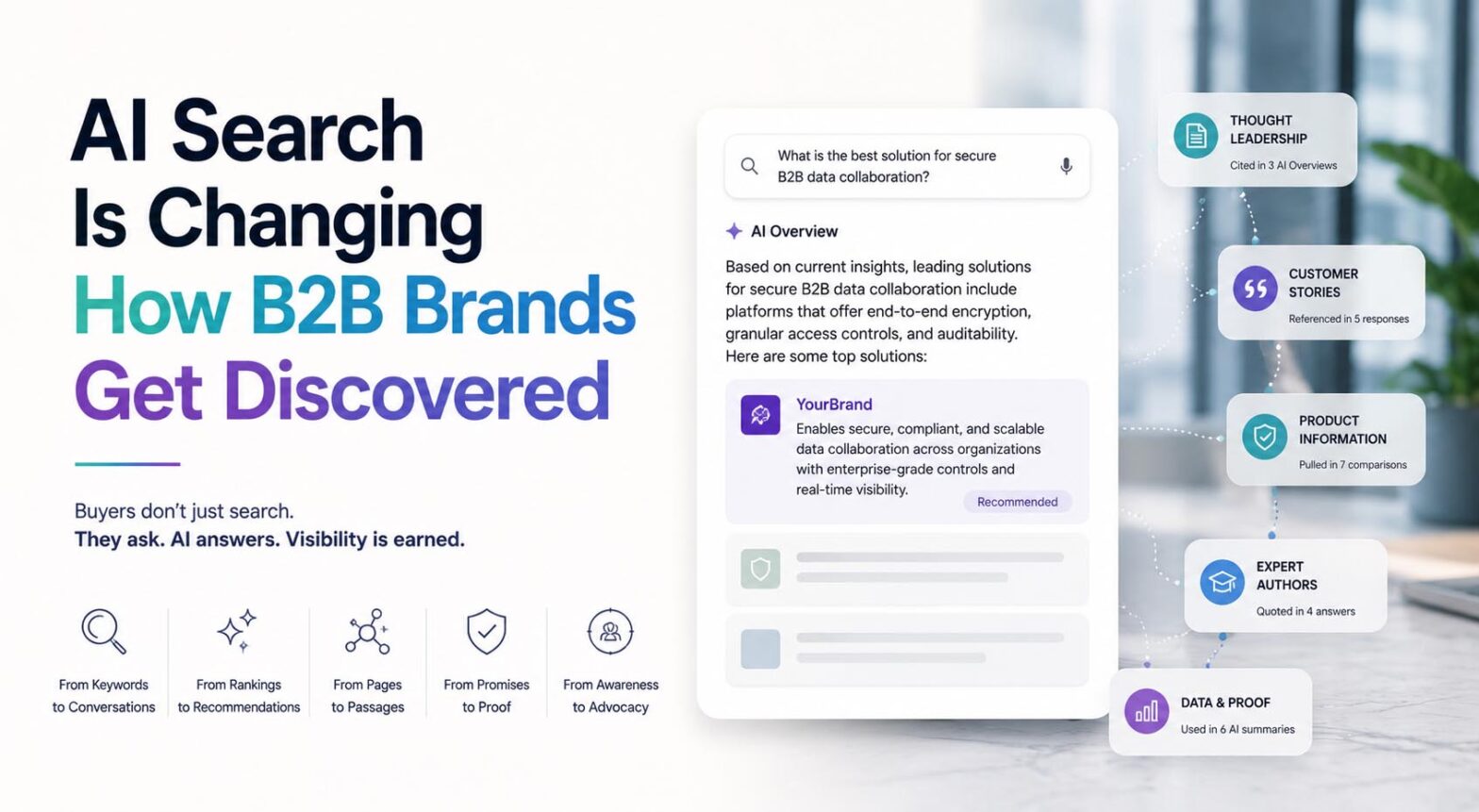
Buyers are increasingly using AI-driven tools to summarize information, compare options, understand categories, explore vendors, and answer business questions. Instead of reading ten pages one by one, they may receive a generated summary that shapes their view before they ever visit a company website.
This creates a major shift for B2B brands.
The question is no longer only, “Can buyers find us on search engines?”
The new question is, “Can AI systems understand, trust, and accurately represent our expertise?”
Discovery is moving beyond traditional search results
Traditional search gave brands a clear path to visibility. If a company created strong content around relevant buyer questions, it had a chance to appear in search results. The buyer then clicked, visited the page, and explored the brand directly.
AI search changes this journey.
A buyer may now ask an AI tool to explain a business problem, compare solution categories, summarize vendor differences, identify buying criteria, or suggest what questions to ask before purchasing. The answer may include information gathered from multiple sources, structured into a single response.
This means the buyer may form an opinion before clicking any website.
For B2B brands, that matters because discovery is moving upstream. The brand may influence the buyer through content, but the buyer may not always interact with that content directly in the same way. AI systems may interpret the brand’s digital presence and summarize it for the buyer.
If the brand’s message is unclear, inconsistent, or thin, it may be misunderstood or ignored.
Clarity is becoming a visibility advantage
AI systems depend on clear information. They need to understand what a company does, who it helps, what problems it solves, and why it is credible.
This makes clarity extremely important.
Many B2B websites still use broad language that could apply to almost any vendor. Phrases like “driving digital transformation,” “unlocking growth,” “empowering businesses,” or “delivering innovation” may sound polished, but they do not explain enough.
If a buyer or AI system cannot quickly understand the company’s value, the brand becomes harder to discover and harder to trust.
B2B companies need to make their positioning specific.
What service is being offered?
Which audience is being served?
Which industries or roles are most relevant?
What outcomes are being created?
What makes the approach different?
What proof supports the claim?
The clearer these answers are across a company’s website and content, the easier it becomes for both buyers and AI systems to understand the brand.
Generic content will lose impact
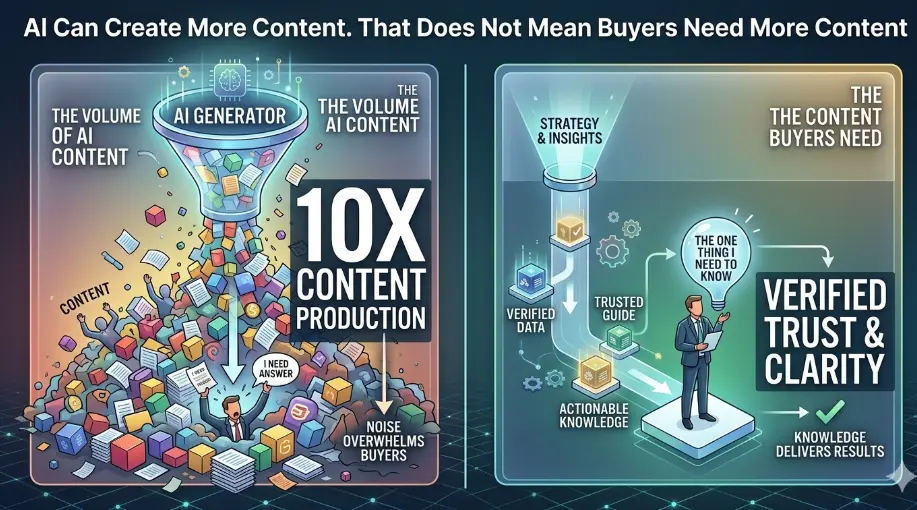
AI has made content creation easier. It has also made generic content easier to produce.
This creates a problem for B2B brands. If every company publishes the same broad articles on the same broad topics, the content becomes less valuable. Buyers do not need another surface-level explanation of a trend. They need practical insight that helps them make better decisions.
AI search is likely to reward content that is clear, useful, structured, and genuinely informative.
That means B2B brands should move away from content written only to fill a calendar. Instead, content should answer real buyer questions.
For example:
- What should buyers know before choosing a demand generation partner?
• How should companies evaluate lead quality?
• What does strong content syndication look like?
• How should sales teams follow up on campaign leads?
• What data signals actually matter in B2B intent?
• How can brands improve trust across the buyer journey?
These questions are more useful than vague trend topics because they connect directly to buyer decisions.
The stronger the answer, the stronger the brand’s authority.
Original insight matters more than volume
In the past, many content strategies focused heavily on volume. Publish more blogs. Cover more keywords. Create more pages. Capture more traffic.
Volume alone is becoming less effective.
AI search is pushing brands toward quality, originality, and authority. A company does not need to publish endless content if the content it does publish is sharp, specific, and useful.
Original insight does not mean complicated research every time. It means saying something that reflects real market understanding.
For Pineapple View Media, this could mean explaining why lead quality depends on fresh data, validation, proper targeting, and buyer intent. It could mean writing about why content syndication should not be measured only by volume. It could mean showing how demand generation works better when sales follow-up carries campaign context.
These are practical views built from experience.
That is what makes content valuable. It does not simply repeat what the market already knows. It explains what matters and why.
Website structure needs to support AI discovery
AI search is not only about blog content. It is also about how information is structured across a website.
A B2B website should make it easy to understand the company’s services, industries, value proposition, proof points, and areas of expertise. Important information should not be hidden inside vague paragraphs or scattered across disconnected pages.
Strong website structure may include:
- Clear service pages
• Industry-specific pages
• Detailed FAQs
• Use case pages
• Resource hubs
• Case study sections
• Glossary-style educational pages
• Strong internal linking
• Consistent page titles and headings
• Clear calls to action
This structure helps buyers navigate the site. It also helps search and AI systems understand relationships between topics.
For example, a company offering demand generation, content syndication, webinar promotion, appointment setting, and data validation should have clear explanations for each service. Each page should explain what the service means, who it is for, what problem it solves, and how success is measured.
Clarity helps discovery.
Consistent messaging is critical
AI search makes consistency more important.
If a company describes itself in one way on its homepage, another way in social content, another way in landing pages, and another way in campaign emails, the market receives a mixed signal. Buyers may become confused. AI systems may also struggle to build a clear understanding of the brand.
Consistent messaging does not mean repeating the same sentence everywhere. It means the core narrative should remain stable.
A B2B company should consistently communicate:
- The audience it serves
• The problems it solves
• The value it delivers
• The proof behind its approach
• The point of view it brings to the market
For demand generation brands, consistency is especially important because the category is crowded. Many companies claim to deliver leads. Fewer clearly explain how they protect quality, validate data, maintain compliance, and support campaign outcomes.
The brands that explain their approach clearly will be easier to understand and remember.
AI search changes the role of SEO
SEO is not becoming irrelevant. It is becoming broader.
Traditional SEO focused on rankings, keywords, metadata, backlinks, technical performance, and content relevance. These still matter. But B2B teams now need to think about answer quality, entity clarity, topical authority, content structure, and trust signals.
In practical terms, this means content should be written to answer questions fully and clearly. Pages should be organized around buyer intent, not only keywords. Claims should be supported by explanation. Service pages should avoid vague language. Articles should connect trends to real business impact.
The goal is not to write for machines instead of people.
The goal is to write so clearly for buyers that machines can also understand the value.
This is an important distinction. Content that is useful to buyers will usually be easier for AI systems to interpret. Content that is vague for buyers will also be weak for AI discovery.
Brand authority will influence discovery
AI-driven discovery is likely to place more value on authority. B2B companies need to build credibility across multiple touchpoints.
Authority can come from strong content, consistent publishing, clear service explanations, original insights, client experience, industry relevance, expert commentary, and useful educational resources.
A company that regularly publishes thoughtful content around B2B demand generation will be easier to associate with that topic. A company that explains lead quality, campaign strategy, buyer behavior, data validation, and sales follow-up in detail will build a stronger content footprint.
This is why InsideHub is valuable.
A content hub is not just a place to post articles. It is a way to build market authority over time. Each article should strengthen the company’s position as a knowledgeable voice in B2B marketing, lead generation, demand generation, and revenue growth.
When done properly, this helps both human buyers and AI-driven discovery systems understand what the brand stands for.
Landing pages must become more useful
AI search may bring buyers to a website later in the journey. By the time they arrive, they may already have some understanding of the topic. This means landing pages must work harder.
A landing page should not only capture a form submission. It should build confidence quickly.
It should explain the value of the asset or offer, the problem being addressed, the audience it is relevant for, and what the buyer will gain. It should avoid generic claims and give enough context for the visitor to feel the exchange is worthwhile.
For B2B campaigns, landing pages are often the bridge between discovery and conversion. If the page is weak, campaign performance suffers. If the page is clear and trustworthy, buyers are more likely to act.
AI search may change how buyers arrive, but the landing page still needs to convert interest into engagement.
What B2B companies should do next
B2B companies should start by auditing their digital presence.
The first step is to check whether the website clearly explains what the company does. If a new visitor cannot understand the business within a few seconds, the positioning needs work.
Next, review the content library. Are the articles original and useful? Do they answer real buyer questions? Are there outdated posts that need updating? Are there thin articles that should be expanded or removed? Are important topics missing?
Then review service pages. Each service should have a clear explanation, practical value, and buyer-focused language. Avoid broad claims that do not explain the process.
Also review FAQs. Buyers often ask practical questions before engaging. A strong FAQ section can help answer those questions and improve clarity for AI discovery.
Finally, review messaging consistency across website pages, LinkedIn posts, email campaigns, landing pages, and sales material. The brand should feel connected across every channel.
Final thoughts
AI search is changing how B2B brands get discovered. Buyers are using new tools to learn, compare, and evaluate before they ever speak to a vendor. This means brands must become easier to understand, easier to trust, and easier to recommend.
The future of B2B visibility will not depend only on ranking for keywords. It will depend on clarity, authority, originality, structure, and consistency.
Companies that publish generic content may become part of the noise. Companies that explain their expertise clearly will have a stronger chance of being found and trusted.
For B2B marketers, the message is simple.
Do not create content only to appear online. Create content that helps buyers think, decide, and act.
In an AI-driven discovery environment, useful brands will be easier to find.
And in B2B, being useful is still one of the strongest ways to win attention.