Account-based marketing has changed.
For many years, ABM was mostly understood as a focused targeting strategy. Companies selected a list of high-value accounts, built campaigns around those accounts, personalized messaging, and tried to engage decision-makers through coordinated marketing and sales activity.
That approach still has value. But in 2026, it is no longer enough.
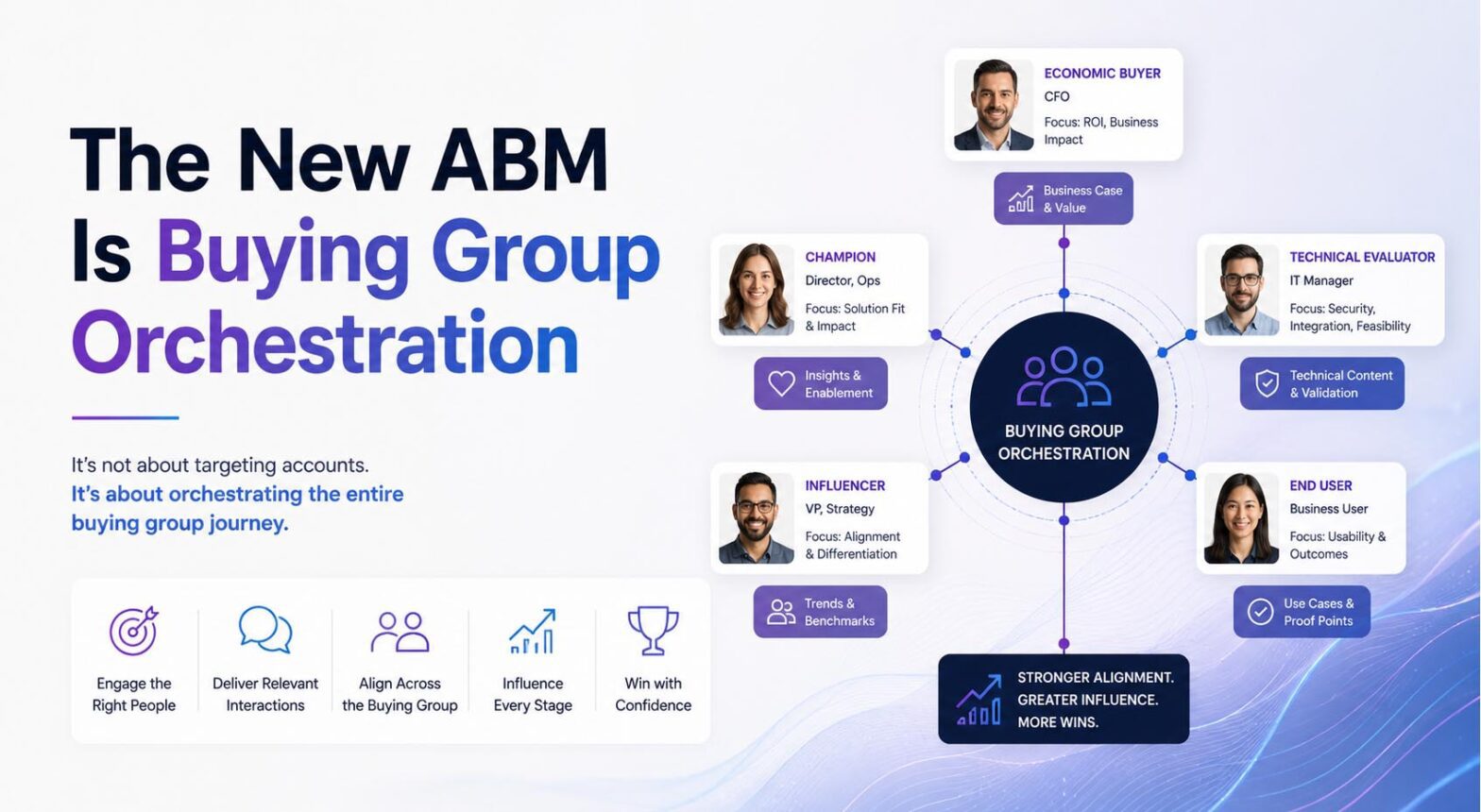
The new ABM is not just about targeting accounts. It is about orchestrating buying groups.
B2B decisions are rarely made by one person. Even when one senior contact appears to be leading the conversation, there are usually several people influencing the decision in the background. Finance may review the budget. IT may assess technical fit. Procurement may check vendor terms. End users may question usability. Leadership may ask about business impact. Legal may review risk.
This means the real challenge is not only reaching the right account. The real challenge is understanding the network of people inside that account and helping them reach a decision together.
Accounts do not buy, people inside accounts do
ABM often starts with the account list. This makes sense because not every company is worth the same level of effort. Businesses need to focus on accounts that match their ideal customer profile, have strong revenue potential, and fit the solution.
But an account name alone does not create pipeline.
A company may look perfect on paper. It may match the right industry, geography, revenue size, employee count, and technology profile. But if the right people inside that company are not engaged, the account will not move.
This is where many ABM programs struggle.
They focus too heavily on the logo and not enough on the buying group. They celebrate engagement from one contact without understanding whether that person has influence. They personalize ads to an account but fail to support the different stakeholders who must approve the decision.
Modern ABM needs a deeper view.
It must answer not only, “Is this account a good fit?” but also, “Who inside this account is involved, what do they care about, and what do they need next?”
The buying committee is getting larger
B2B purchases have become more complex because the risks are higher.
Technology decisions affect security, integration, operations, budgets, data, workflows, and customer experience. Marketing investments are reviewed more carefully. Software purchases often require technical and financial approval. Service partnerships need trust, compliance, and measurable value.
As a result, more people are involved.
A buying group may include:
- A senior decision-maker
• A department head
• A technical evaluator
• A finance stakeholder
• A procurement contact
• A legal or compliance reviewer
• A day-to-day user
• An internal champion
• An external consultant or advisor
Each person has a different concern.
The senior leader may ask whether the solution supports growth. The finance stakeholder may ask whether the investment is justified. The technical evaluator may ask whether it integrates with existing systems. The end user may ask whether it makes work easier. Procurement may ask whether the terms are acceptable.
If ABM messaging speaks to only one of these people, the opportunity can stall.
Why buying group visibility matters
Buying group visibility helps teams understand whether an account is truly active or only lightly engaged.
One person from a target account downloading one asset may be useful, but it may not mean the account is ready. Three or four people from the same account engaging with related content over a short period may be a stronger signal. If those people represent different departments, it may suggest that an internal conversation is forming.
This is the kind of insight ABM teams need.
The goal is not just to track individual leads. The goal is to understand account-level behavior.
Which contacts are engaging?
What roles do they hold?
What content are they consuming?
Are multiple stakeholders active?
Is engagement increasing over time?
Which topics are creating interest?
Is the account moving from education to evaluation?
These questions help sales and marketing teams decide what action makes sense.
Without buying group visibility, teams may either overreact to weak signals or miss strong opportunities.
ABM needs role-specific content
A strong ABM program cannot rely on one message for everyone.
Different stakeholders need different content because they are evaluating different risks and outcomes.
For example, a CFO may want to understand cost efficiency, return on investment, and budget impact. A CTO may want to understand security, scalability, and integration. A marketing leader may want to understand campaign performance and lead quality. A sales leader may want to understand conversion potential and sales readiness. A procurement team may want vendor reliability and compliance information.
If all these stakeholders receive the same generic message, the campaign will feel shallow.
Role-specific content helps buying groups move forward because it gives each stakeholder the information they need to support the decision.
This does not mean creating hundreds of assets. It means building a clear content structure around buyer concerns.
Useful ABM content may include:
- Executive summaries
• Industry-specific pages
• ROI explainers
• Technical guides
• Use case content
• Compliance notes
• Customer proof
• Comparison guides
• Implementation overviews
• Objection-handling assets
The goal is to make internal decision-making easier.
Personalization must be more than a company name
ABM is often associated with personalization. But personalization is frequently misunderstood.
Adding a company name to an email is not enough. Mentioning an industry in a subject line is not enough. Sending a display ad with the account logo is not enough.
Real personalization is based on relevance.
It should reflect the account’s industry, business challenge, buying stage, stakeholder role, and engagement behavior. It should show that the vendor understands the account’s likely concerns.
For example, a financial services company exploring cybersecurity solutions should receive a different message from a retail company exploring customer experience automation. A senior leader should receive a different angle from a technical evaluator. An account that has engaged with early-stage educational content should not receive the same message as an account comparing vendors.
Personalization without strategy becomes decoration.
Personalization with relevance becomes useful.
Sales and marketing must act together
ABM fails when marketing and sales operate separately.
Marketing may run campaigns to target accounts, but if sales does not know what the account engaged with, the follow-up becomes generic. Sales may have strong account knowledge, but if marketing does not use that knowledge in campaigns, messaging becomes weak.
Buying group orchestration requires both teams to work from the same account view.
Marketing should know which accounts sales is prioritizing, which industries matter, which objections appear often, and which stakeholders are most important. Sales should know which campaigns are running, which content was promoted, which contacts engaged, and what the next best action should be.
This creates continuity.
A buyer should not feel like marketing and sales are two separate companies. The journey should feel connected from campaign to conversation.
Intent signals need context
Intent data is valuable in ABM, but it can be misleading if used without context.
A single content interaction does not always mean buying intent. A person may download a report for research. A student may access a guide. A competitor may view a page. A junior employee may engage without influence.
But when intent signals are connected to account fit, role relevance, engagement history, and buying group activity, they become much more useful.
For example, if a target account has multiple contacts engaging with content around the same business challenge, that is worth attention. If those contacts include both senior and operational stakeholders, the signal becomes stronger. If the account also matches the ideal customer profile, sales should act with urgency.
The key is not to treat every signal equally.
Modern ABM needs signal interpretation, not just signal collection.
Buying group orchestration improves sales readiness
When ABM is built around buying groups, sales teams become better prepared.
Instead of approaching an account with a cold pitch, sales can understand which stakeholders are active, what topics they care about, and what concerns may exist. This makes outreach more relevant and conversations more productive.
For example, a sales representative may see that two marketing leaders and one IT manager from the same account engaged with content about campaign data and compliance. That context can shape the conversation. The sales message can acknowledge both performance and data responsibility, instead of using a generic demand generation pitch.
This improves trust.
Buyers are more likely to respond when they feel the vendor understands the situation. Sales teams are more likely to progress opportunities when they have context before outreach.
ABM reporting must evolve
Traditional ABM reporting often focuses on account engagement, campaign reach, lead count, and influenced pipeline. These metrics are useful, but they should be expanded.
Buying group orchestration needs reporting that shows depth of engagement.
Important questions include:
- How many contacts from the account engaged?
• Which roles engaged?
• Which departments were represented?
• What content topics attracted attention?
• Did engagement increase over time?
• Did sales follow up with context?
• Did the account progress to a meeting or opportunity?
• Which assets helped move the account forward?
This kind of reporting gives a clearer view of account health.
It also helps teams avoid false positives. An account may have high impressions but weak meaningful engagement. Another account may have fewer interactions but stronger buying group activity. ABM teams need to know the difference.
Why this matters for demand generation
Demand generation and ABM are becoming more connected.
In the past, demand generation often focused on creating leads at scale, while ABM focused on a smaller group of target accounts. Today, the two approaches increasingly support each other.
Demand generation creates engagement signals. ABM uses those signals to identify account movement. Content syndication, webinars, newsletters, and targeted campaigns can all reveal which accounts and stakeholders are showing interest.
The key is to connect lead-level activity to account-level insight.
This is especially important for B2B companies that want quality over volume. A campaign lead from a target account is useful. Multiple engaged contacts from the same account are more valuable. Engagement from different roles inside the buying group is even stronger.
This is how demand generation can support account-based growth.
What B2B companies should do next
Companies should review their ABM strategy and ask whether it truly reflects how buyers make decisions.
Start with the target account list. Are the accounts selected based on clear ICP criteria? Then review stakeholder mapping. Do you know who matters inside those accounts? Are you engaging multiple roles or relying on one contact?
Next, review content. Does your content support different stakeholders? Can it help a champion build the case internally? Does it answer technical, financial, operational, and executive concerns?
Then review data. Can you see account-level engagement? Can sales understand which contacts engaged and why? Are intent signals being interpreted properly?
Finally, review follow-up. Is sales acting with context or using the same message for every account?
These questions can help shift ABM from account targeting to buying group orchestration.
Final thoughts
The new ABM is not about chasing logos. It is about understanding the people inside those logos.
B2B buying decisions are made by groups, not isolated individuals. Each stakeholder has different priorities, concerns, and influence. ABM programs that ignore this reality will struggle to create momentum.
Buying group orchestration gives companies a stronger way to engage target accounts. It connects account fit, stakeholder behavior, role-specific content, intent signals, and sales action into one coordinated approach.
The result is better relevance, stronger trust, and more meaningful pipeline movement.
For B2B teams, the message is simple.
Winning an account requires more than reaching the account. It requires helping the buying group move forward together.