There is a common belief in B2B today that buyers no longer want to speak to sales teams. It is easy to understand why this idea exists. Buyers do more research on their own. They compare vendors before speaking to anyone. They read content, attend webinars, check reviews, ask peers, and use online resources before filling out a form or accepting a meeting.
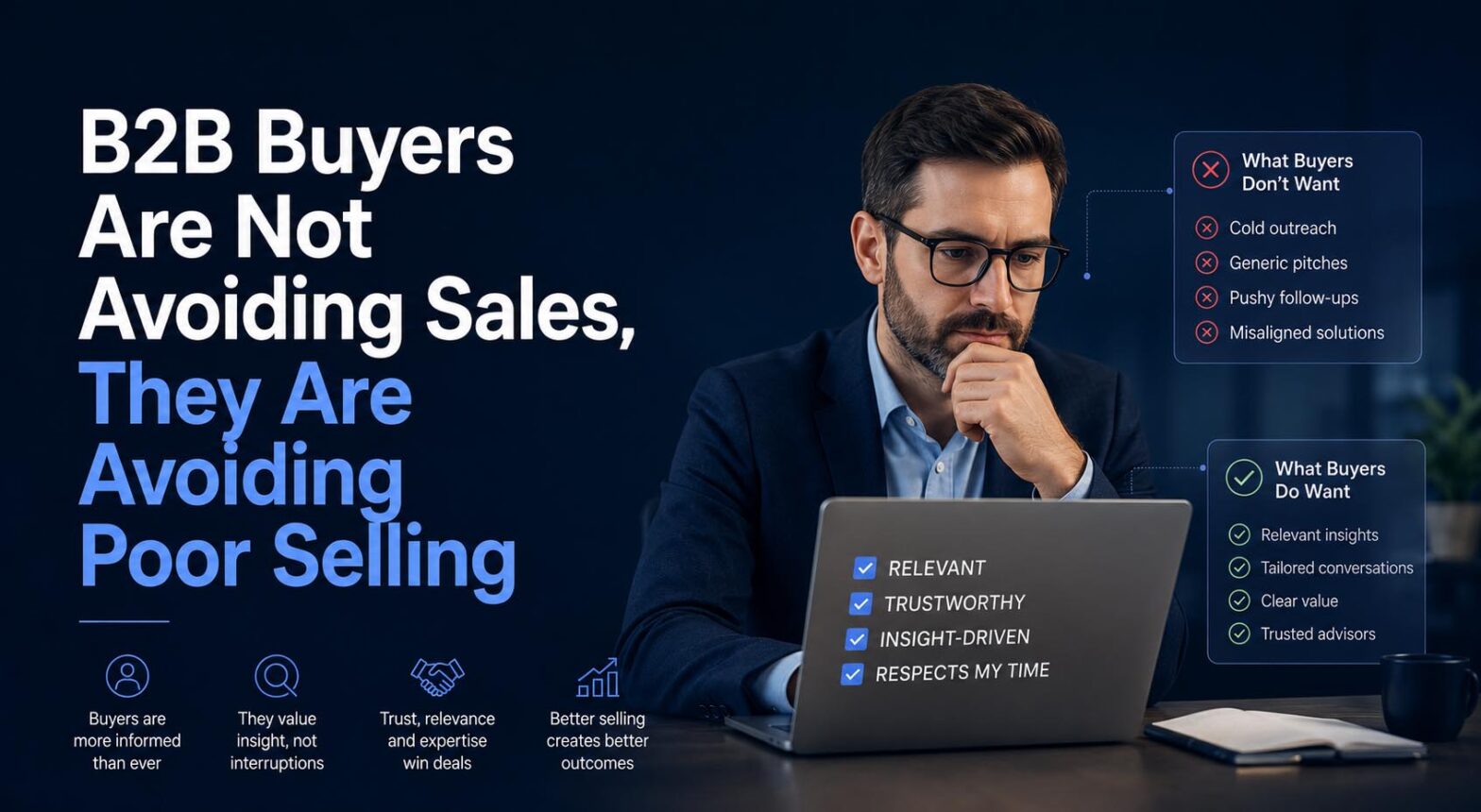
But the real issue is not that buyers are avoiding sales.
They are avoiding poor selling.
Modern B2B buyers still want expert guidance. They still need clarity. They still need help understanding trade-offs, implementation requirements, cost, risk, and expected business impact. What they do not want is a generic pitch that ignores everything they already know.
This is where many sales and marketing teams need to rethink their approach.
The buyer is more informed before the first conversation
A B2B buyer rarely begins their journey by speaking to a vendor. In many cases, the buyer has already spent time researching the problem internally. They may have compared several solutions, downloaded reports, watched product videos, joined digital events, read analyst-style content, and spoken with colleagues before engaging with sales.
By the time they enter a conversation, they are not looking for a basic introduction. They want help making a better decision.
This changes the role of sales.
The salesperson is no longer the main source of information. The salesperson is now a guide who helps the buyer make sense of information. That is a very different responsibility.
A buyer may come into the conversation with strong assumptions. Some may be correct. Some may be incomplete. Some may be shaped by competitor messaging. The best sales teams know how to add clarity without forcing pressure. They help buyers understand what matters, what does not, and what they should consider before moving forward.
Why generic outreach fails
Generic outreach is one of the biggest reasons buyers ignore sales.
A buyer who has engaged with a specific webinar, downloaded an asset, or explored a topic does not want to receive a message that could have been sent to anyone. They expect the follow-up to reflect their interest.
For example, if a prospect downloaded content around customer experience automation, the follow-up should not simply say, “Would you like to schedule a call?” A better message would connect to the topic, acknowledge the challenge, and offer a relevant next step.
The difference may seem small, but it matters.
Buyers are not only judging the product. They are judging whether the vendor understands their situation. A careless message creates doubt. A relevant message creates confidence.
In a crowded B2B market, attention is earned through relevance.
The buying journey is no longer linear
Many B2B teams still think of the buyer journey as a straight path: awareness, interest, consideration, decision. The reality is more complicated.
A buyer may begin with curiosity, then pause because of budget. They may return later because leadership raises the issue again. They may involve IT, finance, legal, procurement, and department heads. They may compare multiple vendors, revisit internal priorities, delay the project, and restart the conversation months later.
This is why timing matters so much.
A lead may be qualified by profile but not ready by intent. Another lead may not look senior enough on paper but may be the person driving the internal conversation. A buying committee may show engagement across multiple contacts before any one individual asks for a meeting.
Sales teams need to understand these patterns. Marketing teams need to support them with better data and stronger nurture.
The goal is not to rush every buyer into a meeting. The goal is to understand where the buyer is and what they need next.
Sales must support internal consensus
Most B2B decisions involve more than one stakeholder. Even when one person appears to be the main contact, they often need approval or support from others inside the company.
This means sales is not just selling to one person. Sales is helping that person build internal confidence.
A champion may need to explain the business case to leadership. A technical buyer may need answers about integration. A finance stakeholder may need cost justification. A procurement team may need vendor documentation. An end user may need to understand how the solution affects daily work.
If sales only focuses on the person who filled out the form, it may miss the larger buying group.
This is where buyer enablement becomes important.
Buyer enablement means giving prospects the information they need to move the decision forward internally. That may include comparison guides, ROI explanations, implementation notes, case studies, security information, product walkthroughs, or stakeholder-specific content.
Good selling does not only persuade the buyer. It helps the buyer persuade the organization.
Marketing content must match the full buying group
This shift has a direct impact on content strategy.
B2B marketing cannot rely on one generic asset for every audience. Different stakeholders care about different things. A senior executive may care about growth, risk, and business impact. A manager may care about process improvement. A technical team may care about integration and security. A finance team may care about cost control and measurable returns.
If the content does not answer these different concerns, the buying journey slows down.
Strong B2B content should support the full decision process. It should educate early-stage buyers, help active buyers compare options, support internal business cases, and reduce uncertainty near decision time.
This is why campaign planning should start with buyer questions.
What problem is the buyer trying to solve?
Who is involved in the decision?
What concerns may slow the deal?
What proof will build confidence?
What content can help the buyer take the next step?
When marketing answers these questions properly, sales conversations become more useful.
The follow-up must carry context
Lead generation does not end when the lead is delivered. In many ways, that is where the real work begins.
A campaign lead should not be treated as just another contact in the CRM. The sales team should know which asset the person engaged with, what topic attracted them, what industry they belong to, what job role they hold, and whether the account has shown other signals.
This context changes the quality of the conversation.
A sales representative who understands the buyer’s interest can open with relevance. A representative who does not have context often falls back on generic messaging.
This is why sales and marketing alignment matters. Alignment is not just about agreeing on targets. It is about making sure campaign intelligence is carried into sales action.
If marketing generates demand but sales does not have the context to continue the conversation, the value is lost.
Technology helps, but it does not replace judgment
AI, CRM systems, intent platforms, and marketing automation tools can all improve buyer engagement. They can show which accounts are active, summarize interactions, suggest follow-up messages, and help prioritize leads.
But technology cannot fix poor selling on its own.
A tool may tell a salesperson that a prospect engaged with a certain topic. It cannot fully understand the internal politics of the buyer’s company. It cannot replace active listening. It cannot build trust through a thoughtful conversation. It cannot turn a weak value proposition into a strong one.
Human judgment still matters.
The best sales teams use technology to prepare better, not to remove effort. They use data to understand the buyer before reaching out. They use AI to summarize and organize, but they still bring business understanding into the conversation.
Buyers can tell the difference between informed selling and automated outreach.
Relevance is the new sales advantage
In B2B, relevance is now one of the strongest competitive advantages.
Relevant selling means understanding the buyer’s role, industry, pain point, stage, and likely concerns. It means using campaign data properly. It means respecting the buyer’s time. It means offering useful information instead of pushing for a meeting too early.
This approach does not weaken sales. It makes sales stronger.
A buyer is far more likely to engage when the message reflects their actual interest. They are more likely to trust a salesperson who understands their challenge. They are more likely to progress when the conversation helps them solve internal questions.
The sales teams that perform best will not be the loudest. They will be the most useful.
Why this matters for demand generation
Demand generation teams need to think beyond lead capture. The quality of the buyer experience after conversion matters just as much as the campaign that created the lead.
If the campaign message is strong but the follow-up is poor, the buyer journey breaks. If the asset is relevant but the sales conversation is generic, trust declines. If the lead is qualified but contacted at the wrong stage, the opportunity may be wasted.
This is why modern demand generation must include follow-up strategy.
Before launching a campaign, teams should define what happens after engagement. What should sales say? What nurture path should be used? What content should be sent next? Which leads need immediate attention? Which leads need education first?
These decisions improve conversion and protect brand trust.
Final thoughts
B2B buyers are not avoiding sales because they dislike human interaction. They are avoiding sales conversations that do not respect their time, research, or needs.
The future of B2B selling is not about pushing harder. It is about helping better.
Sales teams need to act as guides. Marketing teams need to create content that supports real buying decisions. Demand generation teams need to deliver context, not just contacts. Technology needs to improve relevance, not increase noise.
The buyer has changed, but the need for trust has not.
The companies that understand this will create stronger conversations, better pipeline, and longer-term customer relationships.
B2B buyers still want to speak to vendors. They just want those conversations to be worth their time.