Sales enablement has always been important in B2B. Companies have used playbooks, product decks, onboarding sessions, battlecards, case studies, objection-handling notes, and training programs to help sales teams perform better.
These resources still matter.
But the way sales teams need support has changed.
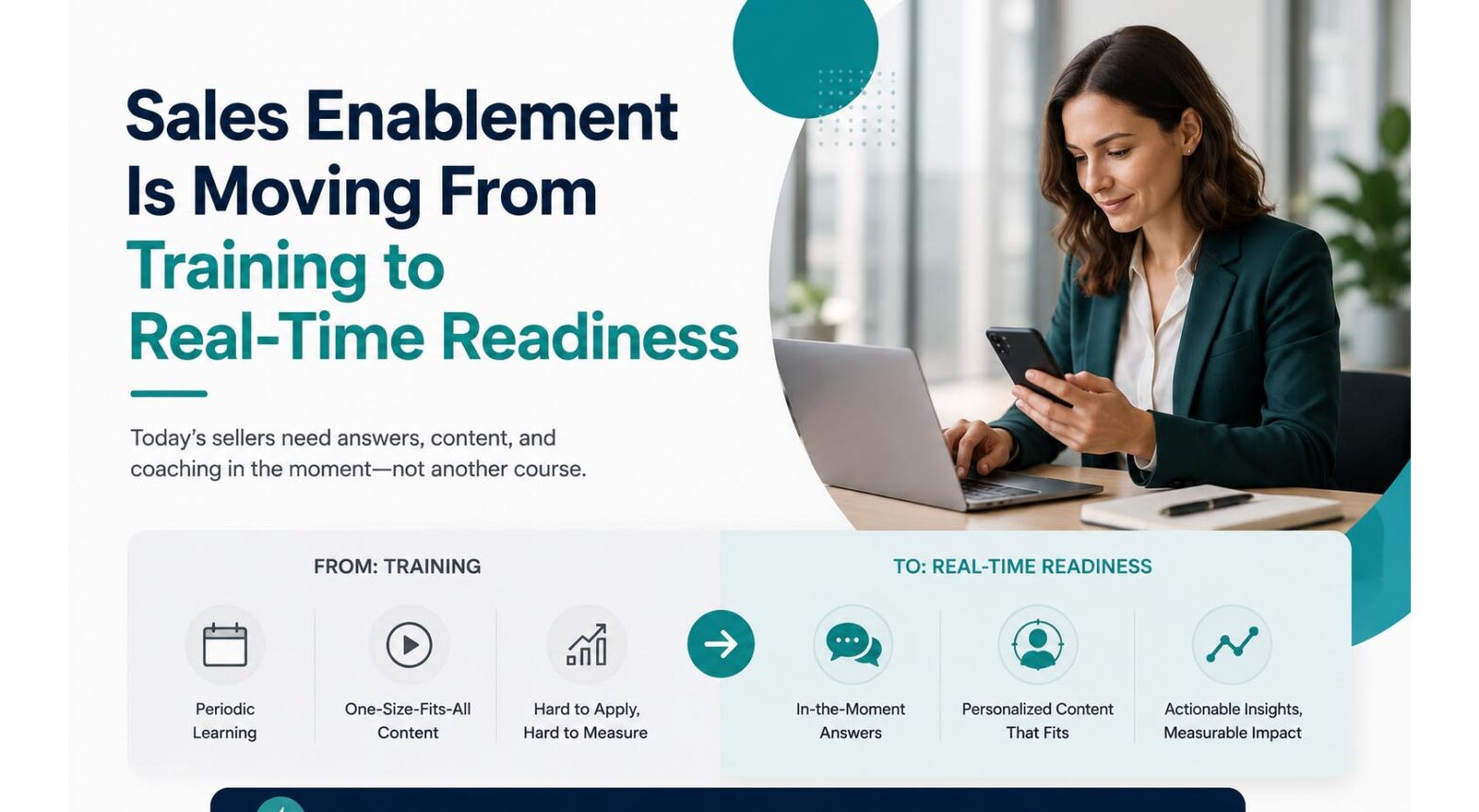
In 2026, sales enablement is no longer only about training. It is about real-time readiness.
B2B buyers are more informed. Sales cycles are more complex. Buying committees are larger. Products and services are more detailed. Competitive pressure is stronger. A sales representative may need to handle business concerns, technical questions, pricing discussions, compliance requirements, procurement objections, and internal stakeholder doubts, sometimes within the same opportunity.
A one-time training session cannot prepare sales teams for every situation.
They need the right insight, content, and context at the exact moment the buyer conversation happens.
Sales enablement used to be too static
Traditional sales enablement often worked like a library.
Marketing teams created assets. Product teams created feature documents. Sales leaders created playbooks. These resources were placed in folders, portals, shared drives, or enablement platforms. Sales teams were expected to know where everything was and when to use it.
The problem was not always the quality of the content.
The problem was access, timing, and relevance.
A salesperson may not know which case study fits a specific industry. They may not remember where the latest pricing document is stored. They may use an outdated deck. They may send a generic asset because finding the right one takes too long. They may enter a call without knowing what campaign the lead came from.
This creates friction.
Sales enablement should not simply store information. It should help sales teams use information at the right time.
That is the shift happening now.
Buyers expect prepared conversations
Modern buyers do not want to explain everything from the beginning.
If they have already downloaded a guide, attended a webinar, clicked a campaign email, or visited a solution page, they expect the vendor to understand that context. They do not want a salesperson to restart the conversation with a basic introduction.
This expectation is reasonable.
Buyers are giving signals through their engagement. Sales teams should be able to use those signals to make the next interaction more relevant.
A prepared conversation feels different. The salesperson understands the buyer’s role, industry, likely challenge, and previous engagement. They do not jump immediately into a pitch. They connect the conversation to what the buyer has already shown interest in.
This builds trust.
An unprepared conversation does the opposite. It makes the buyer feel like the vendor is only chasing a lead, not trying to solve a problem.
Real-time readiness connects data to action
Real-time readiness means sales teams can access the right information when they need it.
This may include:
- The asset a lead engaged with
• The campaign theme
• The buyer’s job role and industry
• Account engagement history
• Suggested follow-up messaging
• Relevant case studies
• Objection-handling guidance
• Product or service notes
• Competitive positioning
• Next-best-action recommendations
• Meeting preparation summaries
The goal is to reduce guesswork.
Sales teams should not have to search across five systems before every outreach. They should have a clear view of the buyer and a practical recommendation for what to do next.
This is especially important in fast-moving campaigns. If a lead shows interest today, a relevant follow-up tomorrow may work well. A generic follow-up two weeks later may lose the opportunity.
Timing and context must work together.
Marketing plays a bigger role in sales readiness
Sales enablement is not only a sales function. Marketing plays a major role.
Marketing creates the campaigns that attract buyers. It shapes the messaging that starts the conversation. It builds the assets that buyers engage with. It understands which themes are being promoted and what each asset is designed to achieve.
If that information does not reach sales, the campaign loses power.
For example, if marketing runs a webinar campaign around AI-driven customer service, the sales team should know the webinar angle, the target audience, the key pain points, the questions discussed, and the recommended follow-up. Without this context, sales may treat the attendees like ordinary leads.
That is a missed opportunity.
Marketing should provide campaign intelligence with every lead handoff. This does not need to be complicated. Even a simple campaign summary can improve sales conversations.
Sales should know why the lead exists.
Content must support real buyer questions
Sales enablement content should be built around the questions buyers actually ask.
Too many companies create assets based on internal priorities. They build decks about features, product updates, company history, and broad value propositions. These may be useful in some cases, but buyers often need more specific support.
They want to know:
- How does this solve our problem?
• What makes this different from other options?
• How quickly can we see value?
• What are the risks?
• How does implementation work?
• What proof do you have?
• How does pricing connect to value?
• What happens after we sign?
• How will this affect our team?
• What should we tell internal stakeholders?
Sales enablement content should answer these questions clearly.
A strong enablement library should include industry-specific examples, role-based messaging, comparison guidance, objection responses, implementation explainers, ROI support, and proof points. It should also be easy to find and use.
The best sales content is not the content that looks best in a folder. It is the content that helps move a real conversation forward.
AI can improve readiness, but only with structure
AI is becoming a useful part of sales enablement.
It can summarize account activity, recommend relevant assets, create meeting briefs, suggest follow-up emails, identify likely objections, and help sales teams prepare faster. It can also help managers identify coaching opportunities from call patterns and sales activity.
But AI cannot help properly if the underlying information is messy.
If assets are outdated, CRM data is incomplete, campaign names are unclear, and sales notes are inconsistent, AI recommendations will be weak. The system may surface the wrong content or create messaging that lacks accuracy.
This is why structure matters.
Companies need clean data, organized content, clear tags, updated messaging, and defined sales stages. AI can then help connect the right information to the right moment.
The goal is not to let AI sell on behalf of the team. The goal is to help salespeople prepare better and act faster with stronger context.
Sales enablement should improve confidence
Enablement is not only about information. It is also about confidence.
A salesperson who understands the buyer’s problem, the company’s value, the competitive landscape, and the proof behind the message will sell differently. They will ask better questions. They will handle objections calmly. They will guide the buyer instead of pushing them.
Confidence is especially important in complex B2B sales.
Buyers are often uncertain. They may be comparing several options. They may be worried about budget approval. They may need to justify the decision internally. A confident salesperson helps reduce that uncertainty.
An unprepared salesperson increases it.
This is why enablement should not only focus on what to say. It should also explain why it matters.
Sales teams need to understand the business context behind the message. They should know the pain points, buyer priorities, market trends, and decision triggers. This helps them sound like trusted advisors rather than script readers.
Training still matters, but it must be continuous
Training is still important. New salespeople need onboarding. Existing teams need product updates. Managers need coaching frameworks. Teams need to understand positioning, qualification, objection handling, and sales process.
But training should not be treated as a one-time event.
B2B markets change quickly. Buyer concerns change. Competitors change. Products evolve. New objections appear. Campaign themes shift. Sales teams need regular updates that keep them aligned with the market.
Continuous enablement may include short weekly updates, campaign briefings, new objection examples, fresh competitor notes, call reviews, content refreshes, and practical role-play sessions.
The goal is to keep sales teams ready every day, not only after a formal training session.
Real-time readiness and continuous training work together. Training builds the foundation. Real-time enablement supports the moment.
Sales and marketing feedback loops are essential
A strong enablement system depends on feedback.
Sales teams hear buyer objections every day. They know which messages work, which assets help, and which questions keep appearing. Marketing needs this information to improve campaigns and content.
At the same time, marketing sees engagement trends that sales may not see. It knows which topics attract interest, which assets convert, which audience segments respond, and which channels are performing.
Both sides need each other.
A useful feedback loop may include:
- Sales sharing common objections
• Marketing sharing campaign performance
• Sales identifying missing content
• Marketing explaining asset purpose
• Sales reporting lead quality
• Marketing refining targeting based on feedback
• Leadership reviewing conversion patterns
This turns enablement into a living system.
Without feedback, content becomes outdated and campaigns become disconnected from real conversations.
Lead follow-up needs enablement support
Lead generation campaigns often fail at the follow-up stage.
The campaign may be strong. The targeting may be correct. The content may attract the right audience. But if sales follow-up is generic or delayed, the opportunity weakens.
This is where enablement matters directly to demand generation.
Every campaign should have a follow-up plan. Sales should know what to say, what not to say, which asset to send next, and how to handle different lead types.
A webinar attendee may need a recap and a practical next step. A content download lead may need additional education. A target account contact may need a more personalized approach. A senior stakeholder may need a business-value angle. A technical stakeholder may need proof and implementation detail.
Enablement should help sales adjust the follow-up based on context.
This improves conversion and protects the buyer experience.
Managers need visibility into readiness
Sales managers also need better enablement visibility.
They need to know whether sales teams are using the right content, following campaign context, handling objections properly, and responding quickly. They also need to identify where individual reps need coaching.
Real-time readiness should help managers answer practical questions.
Are reps prepared before calls?
Are they using updated messaging?
Are they following up with relevant content?
Are they losing deals at the same objection point?
Are new reps ramping fast enough?
Are campaign leads being handled properly?
These insights help managers coach more effectively.
Enablement should not only support individual salespeople. It should help leadership improve team performance.
Measurement must focus on business impact
Sales enablement is often measured through training completion, content usage, or platform activity. These metrics are useful, but they do not show the full picture.
The real question is whether enablement improves sales outcomes.
Useful measurement may include:
- Faster lead response times
• Better meeting conversion
• Improved opportunity progression
• Shorter ramp time for new reps
• Higher usage of relevant content
• Improved sales acceptance of campaign leads
• Better objection handling
• Increased win rates
• Stronger sales and marketing alignment
• More consistent messaging
Enablement should be connected to revenue performance.
If content is used often but does not help conversations, it needs improvement. If training is completed but reps are still unprepared, the training needs to change. If campaign leads are strong but follow-up is weak, enablement must fix the gap.
The goal is not activity. The goal is readiness that improves results.
What B2B companies should do next
B2B companies should begin by auditing their current sales enablement process.
Start with content. Is the library updated, organized, and easy to use? Can sales teams quickly find the right asset for a specific buyer, industry, or objection?
Then review campaign handoff. Does sales receive enough context when leads are delivered? Do reps understand the asset, audience, message, and recommended follow-up?
Next, review training. Is it continuous? Does it reflect current buyer questions? Does it help reps understand the business problem, not just the product?
Then review technology. Are CRM, marketing automation, content systems, and sales tools connected enough to support real-time readiness?
Finally, review feedback. Are sales and marketing learning from each other regularly?
These steps can help companies move from static enablement to active revenue support.
Final thoughts
Sales enablement is moving from training to real-time readiness because B2B sales has become more complex.
Buyers expect prepared conversations. Sales teams need immediate context. Marketing needs to support follow-up with campaign intelligence. Managers need visibility into performance. AI can help, but only when data and content are properly structured.
The strongest enablement systems will not simply store materials. They will guide sales teams in the moment.
They will help representatives understand the buyer, choose the right message, use the right content, and follow up with relevance.
In B2B, readiness is now a revenue advantage.
The companies that invest in real-time sales enablement will give their teams a better chance to turn interest into conversations, conversations into opportunities, and opportunities into growth.