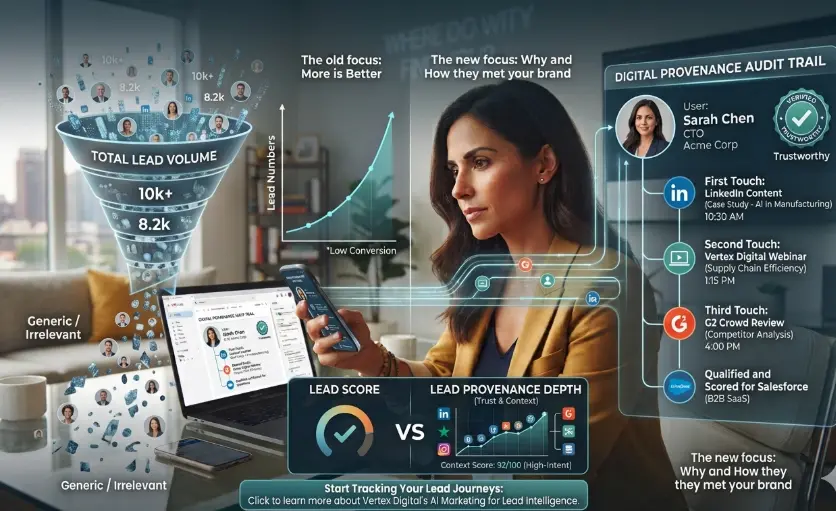

Cost per lead looks clean.
It is easy to track, easy to compare, and easy to report.
That is exactly why so many B2B teams rely on it.
But in 2026, CPL is one of the most misleading metrics in demand generation.
Because it tells you how cheaply you can generate leads, not how effectively you can generate revenue.
And those are two very different things.
The Problem With Optimizing for CPL
At first glance, CPL feels logical.
Lower cost, more leads, better performance.
But this logic breaks quickly.
When campaigns are optimized for CPL, they naturally move toward:
- Broader audiences
- Lower intent prospects
- Easier conversions
- Less friction in forms
This reduces cost.
But it also reduces quality.
You end up generating leads that are:
- Curious, not committed
- Early in the buying cycle
- Not the right decision-makers
And that creates a pipeline that looks strong, but does not convert.
Cheap Leads Are Often the Most Expensive
This is the part most teams miss.
A low CPL does not mean lower cost. It often means hidden cost.
Because cheap leads:
- Require more follow-up
- Take longer to convert
- Have lower close rates
- Consume more sales time
When you factor in:
- Sales effort
- Time to conversion
- Opportunity cost
These leads become significantly more expensive than they appear.
In contrast, higher CPL campaigns that target the right audience often deliver:
- Faster conversions
- Better engagement
- Higher deal values
Which ultimately lowers the true cost of acquisition.
CPL Ignores the Buying Reality of B2B
Modern B2B buying is complex.
Deals involve:
- Multiple stakeholders
- Longer decision cycles
- Higher scrutiny
- Internal alignment across teams
CPL measures a single action, one person filling out a form.
It does not account for:
- Whether that person is part of a buying group
- Whether the account has real intent
- Whether the timing is right
- Whether the deal will progress
This makes CPL a very narrow view of performance in a very complex environment.
Marketing Looks Good, Sales Feels the Pain
CPL often creates a disconnect between marketing and sales.
Marketing reports:
- Low cost per lead
- High volume
- Strong engagement
Sales experiences:
- Low-quality conversations
- Poor response rates
- Limited pipeline movement
Both are technically correct.
But they are measuring different realities.
This is where frustration builds, and alignment breaks.
The Illusion of Performance Reporting
CPL also creates a reporting problem.
It allows campaigns to look successful without driving real outcomes.
For example:
- A campaign generates 1,000 leads at a low CPL
- Only 50 are relevant
- Only 10 convert into opportunities
- Only 2 close
On paper, the campaign looks efficient.
In reality, it is underperforming.
Because the metric being used does not reflect the actual goal.
Why CPL Still Dominates
If CPL is so flawed, why is it still widely used?
Because it is:
- Simple to understand
- Easy to benchmark
- Convenient for reporting
- Widely accepted across teams
And most importantly, it provides quick feedback.
But quick feedback is not always meaningful feedback.
What High-Performing B2B Teams Measure Instead
The best teams have not abandoned metrics.
They have evolved them.
- Cost Per Qualified Lead (CQL)
Instead of measuring every lead, they measure:
- Leads that meet specific criteria
- Leads validated by sales
- Leads with real potential
This immediately improves alignment between marketing and sales.
- Cost Per Opportunity
This shifts focus further down the funnel.
It answers a more important question:
“How much does it cost to create a real sales opportunity?”
This metric filters out noise and highlights what actually works.
- Pipeline Contribution
High-performing teams track:
- How much pipeline a campaign influences
- The quality of that pipeline
- The progression of deals
This connects marketing activity directly to revenue impact.
- Conversion Rates Across Stages
Instead of focusing on the top of the funnel, they measure:
- Lead to MQL conversion
- MQL to SQL conversion
- SQL to opportunity conversion
- Opportunity to close
This reveals where the real issues are.
- Sales Feedback as a Core Metric
Numbers alone are not enough.
High-performing teams actively incorporate:
- Sales feedback on lead quality
- Insights from conversations
- Reasons for deal progression or loss
This adds context that metrics alone cannot provide.
The Real Shift: From Efficiency to Effectiveness
CPL is an efficiency metric.
It measures how cheaply you can generate activity.
But B2B growth depends on effectiveness.
It depends on:
- Targeting the right accounts
- Engaging the right stakeholders
- Driving meaningful conversations
- Converting opportunities into revenue
This requires a different mindset.
Where Most Companies Get Stuck
Even when teams understand the limitations of CPL, they struggle to move away from it.
Because:
- Internal reporting is built around it
- Benchmarks are based on it
- Leadership expects it
- Changing metrics requires alignment across teams
So CPL continues to be used, even when it is not the right metric.
What Needs to Change
Moving beyond CPL does not mean ignoring cost.
It means adding context to it.
Companies need to:
- Redefine success metrics across marketing and sales
- Align on what a “good lead” actually means
- Track performance across the full funnel
- Prioritize revenue impact over lead volume
This creates a more accurate view of performance.
Final Thought
CPL is not useless.
But it is incomplete.
And in a complex B2B environment, incomplete metrics lead to incomplete decisions.
The companies that win are not the ones with the lowest CPL.
They are the ones that understand:
What it actually costs to generate revenue, not just leads.