Every B2B marketer has been pitched the same offer: "We'll deliver you 5,000 leads for $2,000."
It sounds like a great deal. The math is simple. You're getting leads for 40 cents each. Your cost per lead drops dramatically. Your boss is happy. You hit your quarterly targets.
And then reality hits.
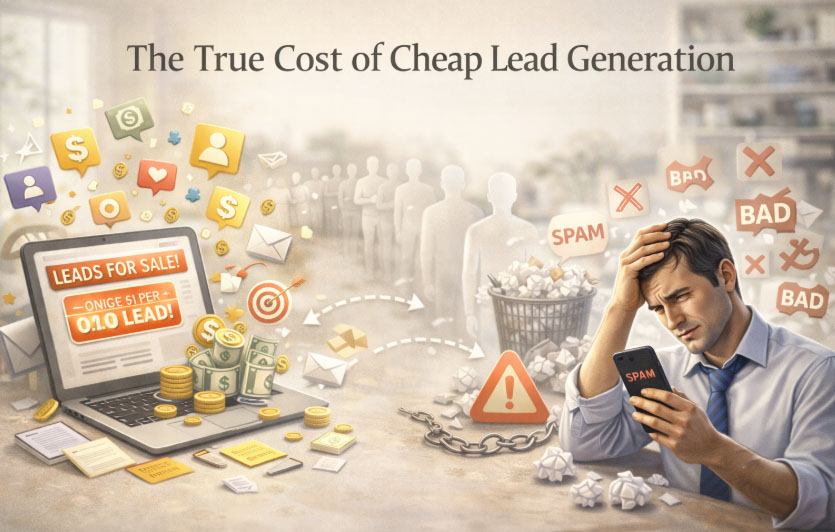
Cheap leads aren't cheap. They just hide their costs in places you're not measuring.
Let's start with why this offer is so tempting.
Compared to running targeted campaigns, buying a list is dirt cheap. Instead of spending $50 or $100 per qualified lead, you're paying less than a dollar.
On paper, it's a no-brainer. More leads for less money. Who wouldn't take that deal?
When you can report that you generated 5,000 leads this quarter, it looks like you're crushing it. Leadership sees growth. Your team sees momentum. The board sees progress.
Volume is easy to measure. Easy to celebrate. Easy to put in a slide deck.
The issues with cheap leads don't show up in your lead gen reports. They show up downstream, in places you're not tracking as closely.
Your sales team's productivity drops. Your conversion rates fall. Your CRM gets polluted. Your campaigns get less effective.
But those costs are diffuse. They're hard to attribute directly to that cheap list you bought. So the real expense stays hidden.
Here's what actually happens when you buy cheap leads.
Let's do some realistic math. Say you buy 5,000 leads for $2,000. Sounds great.
Your sales team spends 5 minutes per lead trying to make contact. That's 417 hours of sales time. If your reps are worth $75/hour (loaded cost), that's $31,250 in labor.
And that's just for initial outreach. If even 10% require follow-up calls, you're adding another 40+ hours.
So your "$2,000 investment" just cost you $31,250 in sales time. And that doesn't even count the opportunity cost of what they could have been doing instead.
Bad data doesn't just sit there. It actively makes your systems worse.
Your lead scoring gets less accurate because it's trained on junk contacts. Your lookalike audiences on ad platforms get polluted. Your email deliverability drops because you're sending to invalid addresses.
Over time, the presence of bad data makes every marketing system you use less effective. And cleaning it up is expensive. Really expensive.
When your sales team is spending 80% of their time chasing bad leads, your conversion rates plummet.
Leadership sees the numbers and asks why marketing-sourced pipeline is down. You scramble to explain. Blame starts getting thrown around.
The real problem? You optimized for cost per lead instead of cost per opportunity. And now your entire team is paying the price.
This one's harder to quantify, but it's real.
Sales reps get frustrated when lead after lead turns out to be a dead end. They start ignoring marketing-sourced opportunities altogether. They go back to cold outreach because at least they know those contacts are real.
Marketing teams get defensive. They feel like they're being blamed for following orders to generate more leads at lower cost.
Trust breaks down. Collaboration suffers. And your entire go-to-market motion gets less efficient.
If cheap leads are so expensive, why do so many companies keep buying them?
Most executives look at cost per lead as the primary metric for demand gen efficiency.
So marketing teams optimize for that number. They find vendors who can deliver leads cheaply. They run broad campaigns that generate volume.
And nobody stops to ask: Are these leads actually turning into revenue?
When you buy cheap leads, the expense shows up in your marketing budget. When your sales team wastes time on them, the cost shows up in your sales budget. When your CRM needs cleaning, it's an ops expense.
The true cost is spread across multiple departments, multiple quarters, and multiple line items. So nobody sees the full picture.
Most marketing teams don't know how to source high-quality leads at scale without spending a fortune on ABM or field marketing.
So they feel stuck choosing between expensive precision campaigns and cheap volume plays. And cheap usually wins because the pressure to show ROI is intense.
Here's what most marketers miss: High-quality lead generation isn't more expensive. It's just priced differently.
Yes, validated, targeted leads cost more than list buys. Instead of $0.40 per lead, you might pay $40 or $60 or more.
That sounds like 100x the cost. But it's not. Because you're not buying the same thing.
Let's run the math differently.
Scenario A: You buy 5,000 leads at $0.40 each. Total cost: $2,000. Your sales team can reach 500 of them (10%). Of those, 50 are actually qualified (1% of total). Of those, 5 close (10% of qualified). Revenue: $250,000 at $50k ACV.
Cost per closed deal: $400 in lead costs + $31,250 in sales time = $31,650 per deal. Plus all the hidden costs we talked about.
Scenario B: You source 500 leads at $50 each. Total cost: $25,000. Your sales team can reach 400 of them (80%). Of those, 200 are qualified (40% of total). Of those, 30 close (15% of qualified). Revenue: $1,500,000 at $50k ACV.
Cost per closed deal: $833 in lead costs + $1,875 in sales time (25 hours at $75/hr) = $2,708 per deal.
The "expensive" leads are actually 90% cheaper per deal. And that doesn't even count the improved CRM health, better team morale, and cleaner attribution data.
High-quality leads don't just convert better. They also eliminate all the hidden costs of cheap leads.
Your sales team isn't wasting time on dead ends. Your CRM isn't getting polluted. Your campaigns aren't degrading. Your team isn't fighting.
That's worth a lot more than the cost per lead difference.
Moving from cheap leads to quality leads requires a mindset change. You have to stop measuring success by cost per lead and start measuring it by cost per customer.
Don't just measure how many leads you generate. Measure how many your sales team actually contacts. How many are qualified. How many turn into opportunities. How many close.
When you track the full funnel, the true cost of cheap leads becomes obvious.
Factor in sales time. Factor in CRM maintenance. Factor in the opportunity cost of chasing bad leads instead of good ones.
When you do the full accounting, high-quality lead gen almost always wins.
The right demand gen partner doesn't just deliver leads and disappear. They validate every contact. They guarantee data quality. And if a lead doesn't meet your standards, they don't charge you for it.
That's a fundamentally different model than buying lists. And it changes the entire equation.
Cheap leads aren't cheap. They just move the cost somewhere else.
You can buy 5,000 contacts for $2,000 and waste tens of thousands of dollars in sales time chasing ghosts. Or you can invest in quality from the start and generate real pipeline that actually converts.
The choice seems obvious. But it requires looking past the headline cost per lead number and focusing on what actually matters: Revenue.
Because at the end of the day, nobody cares how cheap your leads were. They care about how much pipeline you built.