
Introduction
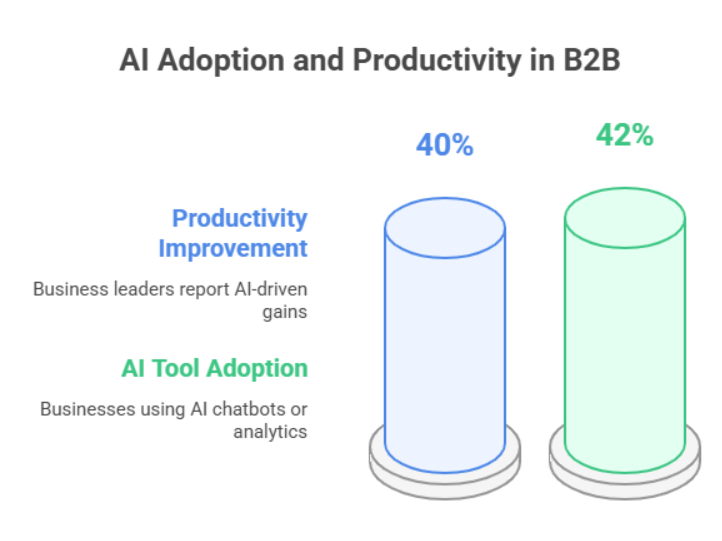
As 2026 begins, B2B organizations are entering a decisive phase in their relationship with artificial intelligence. Over the past few years, AI was introduced as a productivity enhancer, an analytics tool, or an experimental automation layer. In many organizations, it lived on the edges of core systems. That phase is now ending. In 2026, AI is no longer an optional enhancement. It is becoming a foundational dependency across the enterprise.
This shift is not driven by hype. It is driven by necessity. B2B environments are becoming more complex, buyer expectations are rising, and decision windows are shrinking. Manual processes and traditional systems can no longer keep up. AI fills the growing gap between operational complexity and business clarity.
Why 2026 Is a Structural Turning Point for B2B
Several trends converge as 2026 begins. Buying behavior is increasingly AI assisted, meaning buyers arrive more informed and more decisive. Revenue teams face greater pressure to predict outcomes accurately. Data volumes across marketing, sales, finance, and operations have reached a scale that exceeds human analysis. At the same time, regulatory and governance expectations require transparency and precision.
AI becomes essential in this environment because it enables organizations to process information continuously and respond in real time. B2B leaders are realizing that without AI embedded into daily workflows, decision making becomes slower, riskier, and less reliable.
In 2026, AI shifts from being a tool that supports teams to a system that guides execution.
From AI Adoption to AI Dependence
The difference between adoption and dependence is significant. Adoption means teams use AI occasionally to improve efficiency. Dependence means the organization relies on AI outputs to operate effectively.
In a dependent model, AI supports
- Revenue forecasting and pipeline planning
- Buyer intent analysis and prioritization
- Workforce planning and skill mapping
- Infrastructure monitoring and security
- Financial modeling and risk assessment
- Customer experience orchestration
When AI is removed from these systems, performance degrades immediately. That is the signal of true dependence.
How AI Is Becoming the Operating Layer Across B2B Functions
Sales
Sales teams in 2026 depend on AI to interpret buying signals, identify active accounts, and guide engagement strategy. AI analyzes research behavior, stakeholder activity, and historical outcomes to recommend where sellers should focus their time.
Without AI, sales teams struggle to prioritize accounts accurately. With AI, they operate with clarity and confidence.
Marketing
Marketing depends on AI to manage complexity across channels, content, and audiences. AI orchestrates journeys, optimizes messaging, and measures influence across long buying cycles.
In 2026, marketing performance is tied directly to AI driven insight. Manual campaign management becomes unsustainable.
HR and Workforce Strategy
HR teams rely on AI to understand skills, performance patterns, engagement signals, and retention risk. Workforce decisions are no longer based on intuition alone. AI provides visibility into how teams evolve and where investment is needed.
Without AI, workforce planning becomes reactive and fragmented.
IT and Security
IT operations depend on AI to monitor systems, detect anomalies, and prevent incidents before they impact the business. Security teams rely on AI to identify threats in real time across complex environments.
In 2026, IT teams without AI struggle to maintain stability and control.
Finance
Finance teams depend on AI driven forecasting, variance detection, and scenario modeling. AI enables more accurate planning and supports leadership decisions with data driven confidence.
Manual forecasting cannot keep pace with market volatility.
Customer Experience
Customer success teams rely on AI to predict churn, identify expansion opportunities, and personalize engagement. AI allows teams to move from reactive support to proactive value creation.
In 2026, customer experience without AI becomes inconsistent and unpredictable.
Why AI Dependence Creates Competitive Advantage
Organizations that depend on AI operate differently. They respond faster, allocate resources more effectively, and adapt more easily to change.
Key advantages include
- Faster decision cycles
- Reduced operational risk
- Higher consistency across teams
- Better alignment between strategy and execution
- Improved buyer and customer experience
AI dependence allows organizations to scale intelligence, not just headcount.
Challenges of Becoming AI Dependent
AI dependence also introduces responsibility. Organizations must address several challenges.
Data quality becomes critical. AI outputs are only as good as the data that feeds them. Governance frameworks must ensure transparency, fairness, and accountability. Teams must be trained to interpret AI insights correctly and apply human judgment where needed.
Dependence does not mean blind trust. It means structured collaboration between human expertise and machine intelligence.
What B2B Leaders Must Do in 2026
Leaders entering 2026 must ask different questions than before. Instead of asking where AI can help, they must ask where AI is missing.
Key actions include
- Embedding AI into core workflows rather than isolated tools
- Aligning teams around shared AI driven insights
- Investing in data infrastructure and governance
- Training teams to work confidently with AI recommendations
- Measuring success based on outcomes, not activity
The organizations that succeed in 2026 will be those that design AI into the fabric of how work gets done.
The Risk of Standing Still
Organizations that treat AI as optional in 2026 will face growing disadvantages. Slower execution, weaker forecasting, inconsistent customer experience, and higher operational risk will become visible quickly.
As competitors move faster and operate with greater intelligence, the gap widens. Catching up becomes more difficult over time.
Conclusion
2026 marks a clear shift in the B2B landscape. AI moves from adoption to dependence, from experimentation to execution. It becomes the operating layer that connects data, decisions, and outcomes across the enterprise.
B2B organizations that embrace this shift will operate with greater clarity, resilience, and confidence. Those that hesitate will struggle to compete in a market that no longer waits for manual processes or delayed insight. The future of B2B belongs to organizations that trust intelligence as much as they trust experience.