B2B marketers have access to more behavioural information than ever.
Topic consumption.
Website visits.
Content downloads.
Keyword activity.
Webinar registrations.
Email interactions.
Account-level research.
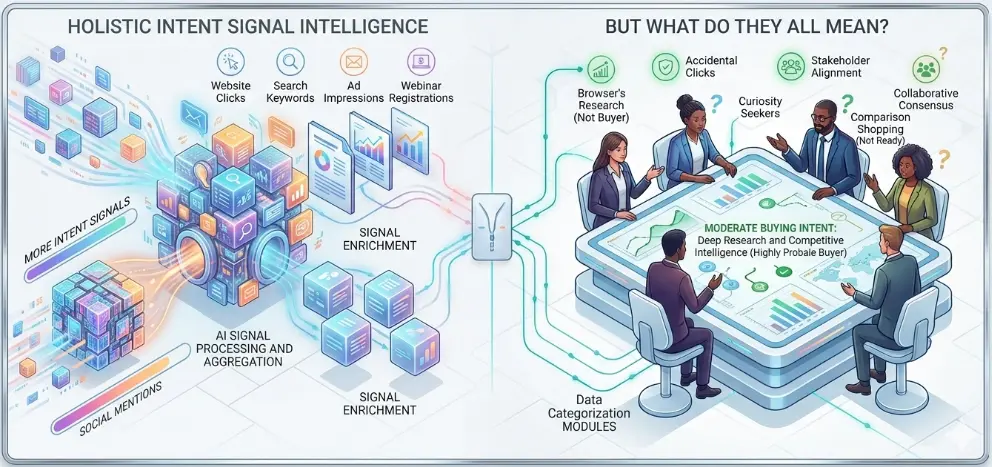
It is tempting to combine enough signals and assume that purchase intent becomes obvious.
Reality is rarely that clean.
Interest is not the same as intent
Someone researching cybersecurity may be:
- Evaluating vendors
- Writing an internal report
- Studying the market
- Preparing a presentation
- Looking for competitor information
- Learning about a new topic
The behaviour is real.
The interpretation can still be wrong.
This matters because many demand generation programmes treat signals as conclusions rather than clues.
Context improves the signal
A single activity tells you very little.
Several connected activities tell you more.
For example:
A relevant job title from a target organisation downloads a detailed buying guide.
Later, additional people from the same organisation engage with related content.
Then the account visits product information.
That pattern deserves more attention than one anonymous spike around a broad industry keyword.
The goal should not be collecting the largest possible number of signals.
It should be understanding which combinations are meaningful.
Human interpretation still has a place
AI will continue getting better at finding patterns across buyer activity.
That is useful.
But marketing and sales teams still need to understand the context behind those patterns.
At Pineapple View Media, we believe intent works best when it complements strong audience targeting rather than replacing it.
Start with the right organisations and people.
Then use behaviour to understand where attention may be developing.
Intent data should help marketers prioritise.
It should not encourage them to treat every digital action as evidence that somebody is ready to buy.
Signals are valuable.
But they are still signals.