There was a time when verifying a B2B lead was relatively straightforward.
Check the email address.
Check the company.
Check the job title.
Check the phone number.
Done.
That is becoming less sufficient.
Automated traffic, scripted form submissions and increasingly sophisticated bots mean a record can look perfectly legitimate while the behaviour behind it is anything but.
Data accuracy and human authenticity are different things
A form submission can contain:
- A real company
- A real employee
- A valid email address
- A correct job title
Yet that still does not automatically prove that the person personally completed the form.
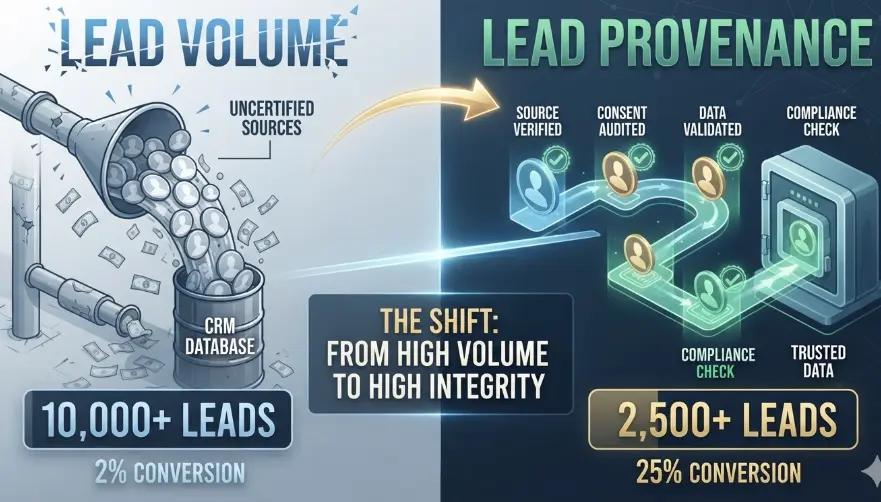
This is why modern lead validation needs two layers.
The first is data validation.
Is the information accurate?
The second is behavioural validation.
Does the interaction look like something a genuine prospect would do?
Behaviour tells a different story
Marketers and publishers can look at signals such as:
- Browser behaviour
- Submission speed
- Repeated patterns
- IP characteristics
- Unusual conversion frequency
- Identical journeys across multiple submissions
- Historical behaviour from similar campaigns
No single signal proves that a submission is genuine or invalid.
The value comes from combining signals.
Humans still matter
There is a temptation to assume that every validation problem needs another automated tool.
Sometimes it does.
But human review remains important because suspicious activity often appears as a pattern rather than a simple rule.
Someone familiar with previous campaigns may recognise unusual behaviour that an isolated automated check misses.
At Pineapple View Media, we see validation as a combination of technology, campaign history and human review.
As AI becomes better at creating human-like behaviour, the definition of "verified lead" will have to evolve with it.
The question will no longer simply be:
"Is this data correct?"
It will increasingly become:
"Are we confident that a real person genuinely engaged?"
That is a much higher standard.
And it should be.