Artificial intelligence has already changed how B2B teams work. It helps marketers write faster, sales teams summarize conversations, analysts review data, and operations teams reduce repetitive tasks. But the next phase is much bigger than productivity.
B2B is now entering the age of agentic AI.
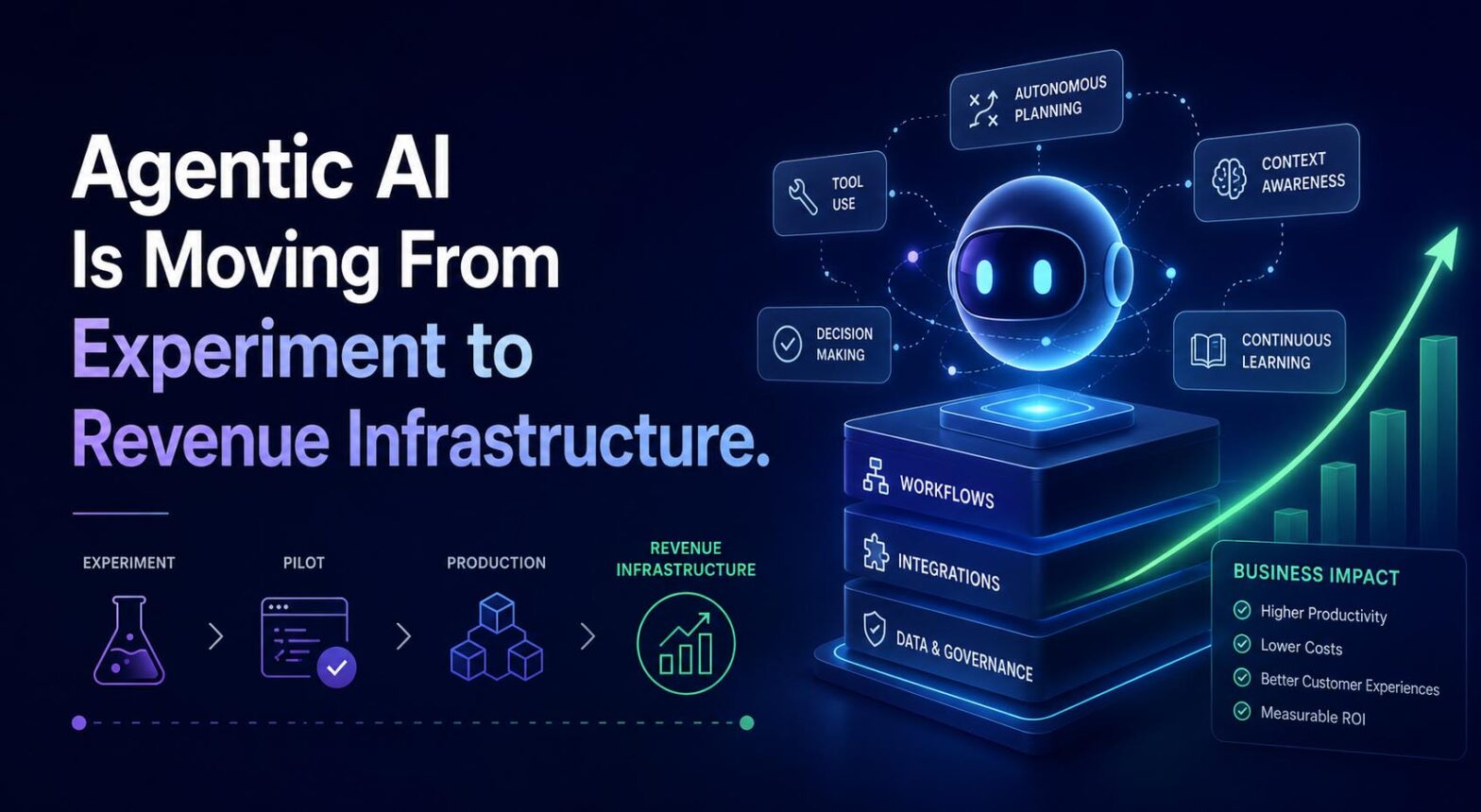
Agentic AI refers to AI systems that can work toward a goal, break that goal into steps, take actions, and improve the process through context and feedback. This is different from simple AI assistance. A standard AI tool may help a marketer write an email. An agentic AI system may help identify the right audience, suggest the campaign angle, check engagement history, recommend follow-up actions, and support lead prioritization.
That is why agentic AI is not just another tool in the marketing stack. It is beginning to look like revenue infrastructure.
Why this matters for B2B teams
Revenue growth has become more difficult. Buyers are more informed. Sales cycles are longer. Buying committees are larger. Budgets are being reviewed more carefully. Marketing teams are expected to do more with better precision. Sales teams are expected to act faster with more context.
At the same time, most companies are dealing with fragmented systems. CRM data sits in one place. Campaign engagement sits somewhere else. Intent signals are tracked separately. Sales notes are not always connected to marketing activity. Reporting often explains what happened, but not always what should happen next.
Agentic AI can help connect these gaps.
It can support teams by identifying which accounts are showing meaningful engagement, which contacts may need nurture, which leads are more likely to progress, and which campaigns need adjustment. It can also help sales teams understand buyer context before outreach, instead of relying on generic follow-up.
The value is not only speed. The real value is better coordination.
From task automation to workflow intelligence
Most businesses have already used automation in some form. Email sequences, CRM workflows, lead scoring rules, campaign triggers, and reporting dashboards have been part of B2B marketing for years.
But traditional automation usually follows fixed rules.
For example, if someone downloads an asset, send Email A. If they click, send Email B. If they do not respond, assign them to nurture. This is useful, but it does not always understand context.
Agentic AI has the potential to work differently. It can consider multiple signals at once. A content download, webinar registration, job role, industry, company size, previous engagement, and account activity can all be reviewed together. The system can then recommend a more relevant next step.
This is important because B2B intent is rarely simple. A single form fill does not always mean someone is ready to buy. A senior decision-maker may engage only once, while a manager may attend multiple sessions and influence the internal discussion. A company may show interest for months before a formal project begins.
Revenue teams need systems that can understand these patterns better.
The data foundation comes first
Agentic AI will only be as strong as the data behind it.
This is where many companies may struggle. If the contact data is outdated, job titles are inaccurate, consent records are unclear, or campaign engagement is poorly tracked, AI will not solve the problem. It may simply move bad information faster through the system.
For B2B companies, the first step is not buying more AI tools. The first step is improving data discipline.
That means:
- Clear ideal customer profiles
• Accurate contact records
• Validated emails and phone numbers
• Defined lead qualification rules
• Proper consent and compliance records
• Connected sales and marketing data
• Regular data hygiene checks
• Clean reporting structures
Without this foundation, agentic AI can create confusion. With the right foundation, it can become a powerful growth engine.
What agentic AI can improve in demand generation
Demand generation is one of the areas where agentic AI can create strong value.
A good demand generation program depends on targeting, timing, content, qualification, and follow-up. If any of these elements are weak, campaign performance suffers.
Agentic AI can support demand generation in several ways.
It can help identify audience segments that are engaging with specific topics. It can recommend which industries or job functions may respond better to a campaign. It can suggest content paths based on buyer behavior. It can help separate early-stage interest from stronger buying signals. It can also support sales handoff by summarizing why a lead may be relevant.
This is especially useful in content syndication, webinar promotion, and account-based campaigns, where engagement data can provide important signals. A lead who has interacted with one asset may need education. A lead who has interacted with multiple assets in the same topic area may need a stronger follow-up. An account with several engaged stakeholders may need sales attention.
The goal is not to replace human judgment. The goal is to help teams act with better information.
Human strategy still matters
There is a risk in treating AI as a complete replacement for strategy.
B2B buying is still human. Buyers have internal pressure, budget limits, technical concerns, leadership expectations, and personal accountability. They do not make decisions only because an algorithm scores them as ready.
AI can identify signals. Humans still need to understand the meaning behind those signals.
A campaign manager still needs to decide whether the message is strong. A sales leader still needs to judge whether the opportunity is worth pursuing. A marketer still needs to understand the buyer’s pain point. A business leader still needs to decide how AI should support the wider revenue model.
The strongest teams will use AI to improve decision-making, not avoid it.
Why poor AI use can damage trust
B2B buyers are already surrounded by automated communication. Many inboxes are filled with generic emails that sound polished but feel irrelevant. AI can make this problem worse if companies use it only to increase volume.
More outreach does not mean better outreach.
If agentic AI is used poorly, it can create faster spam, weaker personalization, and more disconnected buyer experiences. That damages trust. It also makes it harder for genuine, relevant communication to stand out.
This is why governance matters. Businesses need clear rules on how AI is used in sales and marketing. They need quality checks, approval processes, data protection standards, and clear ownership. AI should make communication more relevant, not more careless.
For B2B brands, trust is still the most important asset.
The future revenue team will be AI-supported
The future of B2B revenue will not be AI versus people. It will be AI-supported teams versus disconnected teams.
AI-supported teams will have better visibility into accounts. They will understand buyer engagement faster. They will personalize follow-up with more context. They will identify campaign gaps sooner. They will reduce manual work and spend more time on strategy.
Disconnected teams will continue to struggle with scattered data, slow follow-up, weak qualification, and unclear reporting.
This is where the competitive advantage will emerge.
Not every business needs a fully advanced AI system immediately. But every B2B organization should start asking where AI can improve the quality of its revenue process.
The better questions are:
- Are we using AI to improve relevance or just increase output?
• Is our data strong enough to support intelligent automation?
• Are sales and marketing connected around the same buyer signals?
• Are we using AI to support better decisions?
• Do we have governance around how AI touches buyer communication?
These questions matter because AI adoption without structure can create more problems than it solves.
What B2B leaders should do next
Agentic AI should be approached as a strategic capability, not a short-term experiment.
B2B leaders should begin by reviewing their existing revenue process. Where is work repetitive? Where is data scattered? Where are leads getting delayed? Where is sales missing context? Where are campaigns producing activity but not enough movement?
Once those gaps are clear, AI can be introduced with purpose.
The best starting points are often practical. Improving lead routing. Summarizing account engagement. Recommending nurture paths. Helping sales prepare for outreach. Identifying stronger intent signals. Creating better campaign reporting.
Small improvements can create meaningful impact when they are connected to revenue outcomes.
Final thoughts
Agentic AI is moving from experiment to infrastructure. It is changing how B2B teams think about campaigns, data, sales readiness, and revenue execution.
But the companies that benefit most will not be the ones that simply adopt the newest tools. They will be the ones that combine AI with clean data, strong process, buyer understanding, and responsible governance.
The future of B2B growth will depend on precision. Agentic AI can support that precision, but only when the foundation is right.
AI can accelerate the workflow. Strategy must still guide it.
For B2B companies, that is the real opportunity. Not more automation for the sake of speed, but smarter revenue execution built around relevance, quality, and trust.