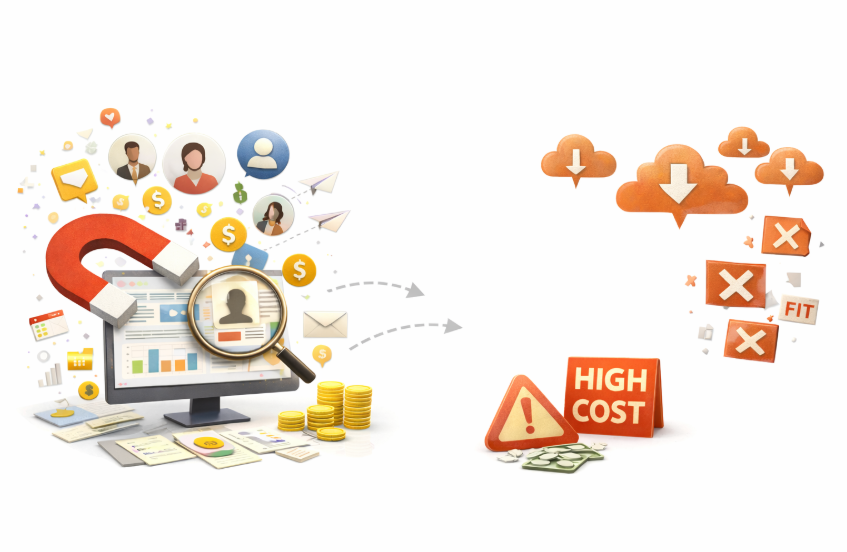
SaaS customer acquisition has become an arms race. Companies are spending more on ads, hiring more SDRs, and building bigger marketing teams. And yet, CAC keeps climbing while conversion rates keep falling.
Something's broken. And it's not for lack of effort.
The problem is that most SaaS companies have adopted the same playbook. They're all running PLG motions with freemium models, or they're all doing enterprise sales with the same ABM tactics. They're all competing in the same channels with similar messaging.
And when everyone does the same thing, nobody wins. Costs go up. Differentiation disappears. And buyers tune out.
The SaaS companies that are actually winning in 2026 have figured out something different. They've stopped copying each other and started building acquisition strategies that match how their actual buyers want to engage.
Most SaaS companies fall into one of three acquisition models. Let's talk about what works and what doesn't in each.
This is the Slack playbook. Free trial or freemium. Let users experience the product. Convert them to paid once they see the value.
It works brilliantly when your product is simple to adopt, has immediate value, and spreads virally through teams.
It breaks when your product requires implementation, has a long time-to-value, or needs executive buy-in. You end up with thousands of free users who never convert because they can't get organizational adoption without top-down support.
This is the Salesforce playbook. Big sales team. Long sales cycles. High ACVs. Executive engagement from day one.
It works when you're selling complex solutions with six-figure contracts into large organizations with formal procurement processes.
It breaks when you try to apply it to mid-market deals that don't justify the sales cost. Your CAC becomes unsustainable and your sales team spends time on deals that don't close.
This is the "we do both" approach. PLG for smaller customers. Sales-led for enterprises. Sounds smart.
In practice, it often means you're doing both poorly. Your product isn't optimized for self-service. Your sales team isn't equipped to close enterprise deals. And prospects get confused about how to buy from you.
Here's what these models have in common: They're all inward-focused. They start with your company's preferred go-to-market motion and try to force buyers into it.
But buyers don't care about your GTM strategy. They care about solving their problems with minimal friction.
Some buyers want to trial your product themselves. Some want to talk to sales. Some want a demo first. Some want pricing upfront. Some want a consultative approach.
The companies that win are the ones that meet buyers where they are, not where they want them to be.
Let's talk about what actually moves the needle on customer acquisition cost.
This is the single biggest factor. If you're reaching people who are actively searching for a solution, your conversion rate goes up 5x or 10x.
If you're reaching people who aren't thinking about the problem yet, you're doing education and awareness. That's expensive and slow.
The companies with the lowest CAC are the ones who have figured out how to identify and target in-market buyers precisely.
Most SaaS companies lead with features. "We have AI-powered analytics." "We integrate with 500 tools." "We're SOC 2 compliant."
But buyers don't care about features until they understand how you solve their specific problem.
The companies with the best conversion rates lead with outcomes. "Cut your month-end close from 10 days to 3." "Reduce security incidents by 60%." "Eliminate manual data entry."
That's what breaks through.
Every extra step in your sales process is a conversion killer. Every form field you ask for. Every meeting you require. Every piece of information you don't provide upfront.
The companies with the lowest CAC have ruthlessly eliminated friction. They make it easy to understand their pricing. Easy to start a trial. Easy to talk to someone. Easy to buy.
This one gets overlooked, but it's massive. When your CRM is full of bad data, your entire acquisition machine breaks down.
Your targeting gets worse. Your lookalike audiences degrade. Your sales team wastes time on bad leads. Your attribution is wrong.
Clean data means better targeting, better conversion, and lower waste. That directly impacts CAC.
Here's where most SaaS companies go wrong on targeting.
They define their ICP based on firmographics. "We target mid-market companies with 200 to 2000 employees in the financial services industry."
That's a start. But it's not enough.
Within that ICP, there are companies that need your solution right now. And there are companies that won't need it for another two years.
If you're spending equal effort on both, you're wasting half your budget.
The companies with the lowest CAC layer intent data on top of firmographics.
They identify which companies within their ICP are actively researching solutions. Which ones are hiring for relevant roles. Which ones are showing signals that they're in-market.
Then they focus their resources there. Not because the other companies won't eventually buy. But because those are the ones who will buy now.
Even within in-market companies, not everyone matters equally.
The intern who downloaded your whitepaper doesn't have buying authority. The IT manager might have influence but not budget. The CFO has budget but might not be engaged.
You need to know who the actual decision-makers are. And you need clean, verified contact data for them.
Most SaaS companies skip this step. They target at the account level and hope they find the right person. That's expensive.
Let's talk about content strategy. Most SaaS companies are doing it wrong.
They create generic thought leadership. "5 Trends in Digital Transformation." "The Future of Work." "Why AI Matters."
This content gets engagement. It doesn't drive conversions.
The content that actually impacts CAC is ruthlessly specific.
"How to reduce month-end close time when you're running on QuickBooks and Excel." That's for a specific buyer with a specific problem.
"The CFO's guide to evaluating new finance platforms without disrupting current operations." That's for a specific decision-maker at a specific stage.
This content doesn't get as many downloads. But the people who do download it are far more likely to convert.
Even when you generate high-quality leads, your sales team can kill your CAC if they're not set up correctly.
Time kills deals. The faster you respond to inbound interest, the higher your conversion rate.
If someone fills out your demo request form and it takes 48 hours to hear back, they've probably talked to three competitors already.
When your sales team reaches out to a lead, do they know: - What content the prospect consumed? - What pages they visited on your site? - What their company is currently using for your solution? - What challenges they're likely facing?
If not, every conversation starts from zero. That's inefficient and frustrating for the buyer.
Not every lead is ready to buy. Some need education. Some are doing early research. Some are comparing vendors.
If your sales team treats every lead the same, they're wasting time on people who aren't ready and alienating people who are.
Good qualification means routing the right leads to the right motion at the right time.
The SaaS companies with the lowest CAC in 2026 have a few things in common.
They don't cast a wide net and hope. They identify companies showing buying signals and focus there.
Their content speaks to specific problems for specific buyers. It's not trying to be everything to everyone.
They don't rely on self-reported form fills or purchased lists. They verify every contact before it enters their system.
They make it easy to understand pricing. Easy to start a trial. Easy to talk to someone. Easy to buy.
Their sales team knows who they're calling, why they should care, and what the buyer is trying to solve.
Here's the uncomfortable truth: Lowering CAC requires investing more upfront in targeting, data quality, and enablement.
You have to spend money to identify in-market accounts. You have to spend money to validate your data. You have to spend money to create really specific content.
But that upfront investment pays for itself in higher conversion rates, faster sales cycles, and lower wasted spend.
The companies that try to save money on the front end end up spending 3x more on the back end chasing bad leads and running inefficient campaigns.
CAC isn't going down because buyers are getting easier to reach. It's going up because everyone's competing the same way in the same channels.
The companies that break out are the ones that stop following the standard playbook and start building acquisition strategies that match how their buyers actually want to engage.
That means precision targeting. Clean data. Specific content. And ruthless elimination of friction.
It's more work upfront. But it's the only sustainable way to acquire customers at scale in 2026.