Every B2B marketing platform claims to be AI-powered now. Your CRM uses AI. Your email tool uses AI. Your content syndication partner uses AI. Even your LinkedIn ads manager has an AI assistant.
But here's the question nobody's asking: Is any of it actually making your demand gen better?
For most teams, the answer is no. They're paying more for tools with "AI" in the name, but they're still dealing with the same problems. Bad lead quality. Poor targeting. Wasted budget.
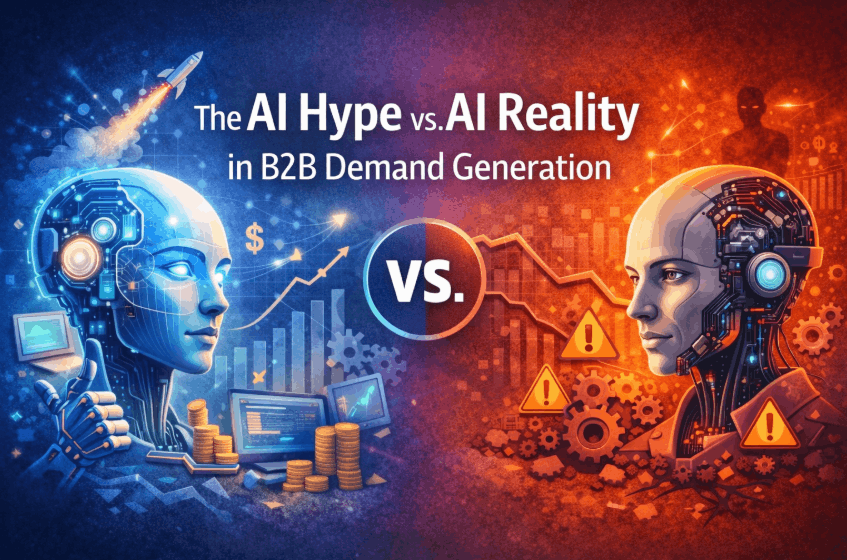
The gap between AI hype and AI reality in B2B demand gen is massive. And it's costing companies a lot of money.
Let's start with what AI is genuinely good at in the context of demand generation.
Machine learning algorithms can analyze massive datasets and identify patterns that humans would never spot. Which companies tend to convert? Which job titles engage most with your content? Which signals indicate buying intent?
When applied correctly, this is incredibly valuable. It can help you refine your ICP, improve your targeting, and prioritize your outreach.
Routine tasks like lead scoring, email sequencing, and audience segmentation can be automated using AI. This frees up your team to focus on strategy and creative work.
The keyword here is "routine." AI works best when the rules are clear and the outcomes are predictable.
This is where most AI tools break down. They can tell you that someone visited your pricing page. They can't tell you why. They can suggest that a company is in-market. They can't tell you who the decision-maker is or what their actual pain points are.
AI lacks context. And in B2B sales, context is everything.
The problem isn't AI itself. The problem is how it's being sold.
You've seen the pitch. "Our AI-powered platform will automatically identify your best prospects, personalize your messaging, and close deals while you sleep."
It sounds amazing. But in reality, most AI tools are just doing basic automation with a fancy label. They're not magic. They're not replacing human judgment. And they're definitely not closing deals on their own.
This is the biggest misconception. Teams assume that if they throw AI at their data, it will somehow become clean and actionable.
It doesn't work that way. AI trained on bad data produces bad results. If your lead database is full of outdated contacts, incorrect titles, and fake emails, no amount of AI is going to fix it.
Garbage in, garbage out. That's still true in 2026.
Here's what AI can't do: It can't tell you who your ICP should be. It can't build your messaging. It can't decide which channels to invest in. It can't determine your positioning.
Those are strategic decisions. They require human expertise, market knowledge, and judgment. AI can support those decisions, but it can't make them for you.
Let's be clear: AI isn't useless. When applied to the right problems, it can be incredibly effective.
One of the best uses of AI in demand gen is analyzing intent signals. Which companies are researching topics related to your solution? Which decision-makers are engaging with content in your category?
AI can process millions of data points across the web to identify these signals in real time. That's something humans simply can't do at scale.
Traditional lead scoring is based on fixed rules. Someone downloads a whitepaper? Add 10 points. They visit your pricing page? Add 20 points.
AI-powered lead scoring is dynamic. It learns from your historical data to identify which behaviors actually correlate with conversion. And it adjusts over time as your business changes.
When done right, this dramatically improves your sales team's efficiency. They spend time on leads that are actually likely to close.
Personalizing content for every prospect manually is impossible. AI makes it feasible.
You can dynamically adjust messaging based on industry, company size, role, or behavior. You can serve different resources to different segments automatically. You can tailor your nurture sequences based on engagement patterns.
This isn't magic. It's just smart automation. But it works.
Here's where things get murky. A lot of demand gen vendors have rebranded their services as "AI-powered" without actually changing how they operate.
They're still buying the same lists. They're still syndicating content to the same broad audiences. They're still delivering the same low-quality leads.
The only difference is the marketing language.
You can use AI to score leads, segment them, and prioritize them. But you still need humans to validate that the data is accurate.
Is the email address real? Is the contact still at the company? Do they actually have decision-making authority?
No AI tool answers those questions reliably. That requires manual verification.
AI can help you build better lookalike audiences. It can suggest companies that fit your ICP. But it can't ensure that your content is reaching the right person at the right company at the right time.
That requires a combination of technology and human expertise. And most vendors are heavy on the former, light on the latter.
The companies that are getting real ROI from AI in demand gen aren't chasing the hype. They're using AI where it actually adds value and relying on human expertise for everything else.
AI informs their decisions. It doesn't make them. They use predictive analytics to refine their ICP. They use intent data to prioritize accounts. They use automation to scale their outreach.
But the strategy? That's still human-driven.
When a vendor says their platform is "AI-powered," smart buyers ask follow-up questions. What exactly is the AI doing? How is it trained? What data is it using? What are its limitations?
If a vendor can't answer those questions clearly, it's a red flag.
AI is only as good as the data it's trained on. So smart teams prioritize data hygiene before they invest in AI tools.
They clean their CRM. They validate their leads. They eliminate duplicates and outdated contacts. Only then do they layer on AI-powered scoring and segmentation.
AI will continue to get better. Models will get smarter. Tools will get more sophisticated. But the fundamentals won't change.
AI will help you analyze data faster. It will help you automate repetitive tasks. It will help you identify patterns and optimize performance.
But it won't replace the need for clean data. It won't replace the need for strategic thinking. And it won't replace the need for human validation.
The teams that succeed in 2026 and beyond will be the ones that use AI as a tool, not a crutch.
They'll combine the speed and scale of automation with the judgment and expertise of experienced marketers. They'll demand quality data and precise targeting. And they'll hold their vendors accountable for results, not just promises.
Because at the end of the day, it doesn't matter how advanced your AI is. What matters is whether your leads convert.
Want demand gen that's smart, not just "AI-powered"? Let's talk.